Which Is Nicer, Lake Como Or Garda?
A fact-led comparison of Lake Como and Lake Garda: size, access, transport, water time, crowds and costs, with the boat trips that make the case for Garda.
Which Is Nicer, Lake Como Or Garda?
Neither lake wins on taste alone, so any honest answer runs on measurable differences. Garda is the largest Italian lake, at 370 square kilometres, 54 kilometres long and 346 metres deep, with 28 public ferry landing stages and a daily wind pattern that made it the sailing lake. Como is smaller at 146 square kilometres, deeper at 414 metres, steeper-shored and more villa-famous. Garda is easier to reach, easier to get around and cheaper on the water.
That is the short version, and the rest of this article is the long one. The question people actually type into a search box is "lake como vs lake garda", and most of what they find back is opinion dressed up as fact: one lake is romantic, the other is sporty, one is for celebrities, the other is for German families in August. There is truth buried in those stereotypes, but the stereotypes are useless for planning. What helps is knowing which lake does what, at what price, and how hard it is to reach without a car.
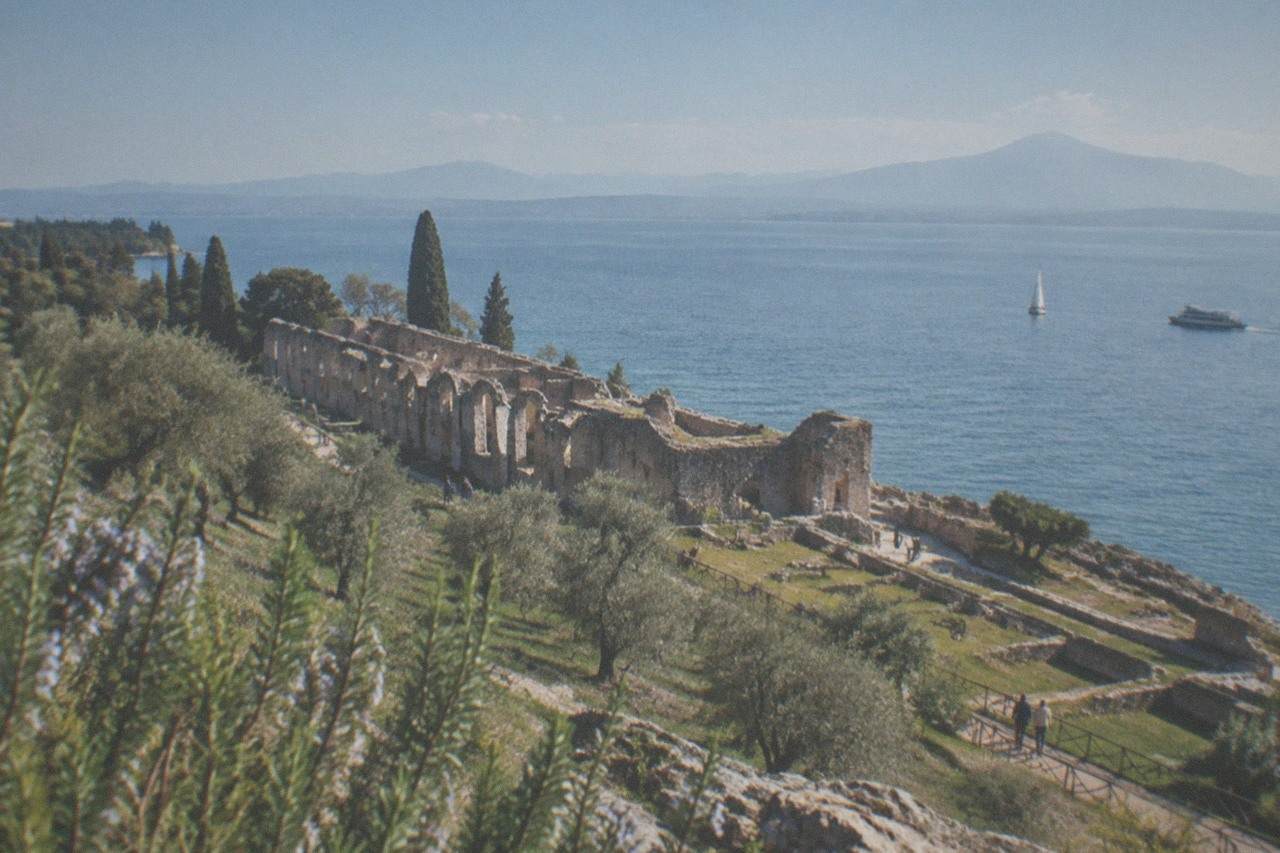
The honest starting point is that the two lakes are not really rivals. They sit about a hundred kilometres apart, at opposite ends of two different holiday styles. Como, an upside-down Y of deep water squeezed between steep wooded walls, is a villa-and-lakeview destination: you come to look at the shore from a boat or a garden, and the famous towns, Bellagio, Varenna, Menaggio, are small, polished and expensive. Garda is a long, varied basin with a genuine tourist infrastructure on top of a working ferry network: olive groves and lemon houses in the north, Roman ruins and wine towns in the south, and a public boat service that runs to 28 landing stages from Desenzano to Riva del Garda.
If you are still deciding whether the lake is worth the trip at all, the deeper background is in why Lake Garda is famous and the practical verdict in is Lake Garda worth visiting. This page stays on the comparison.
How Do The Two Lakes Differ In Size?
Garda is roughly two and a half times the area of Como and about seven kilometres longer, while Como is the deeper lake by a clear margin. Britannica puts Garda at 370 square kilometres, 54 kilometres long, up to 18 kilometres wide and 346 metres deep; the same reference gives Como 146 square kilometres, about 47 kilometres long and 414 metres at its deepest. Garda also has the longer usable shoreline, 125 kilometres, far more of it reachable by boat.
Those figures matter more than they look. Garda's extra width is what gives it bays, islands and a south basin wide enough to feel like a small sea, which is why its ferry network and its sailing scene exist at the scale they do. Como's depth, the deepest of any Italian lake between Argegno and Nesso, is what keeps its water cool and its shores steep: the mountains drop straight into the lake, so the towns are thin, vertical strips with little flat land between shore and cliff.
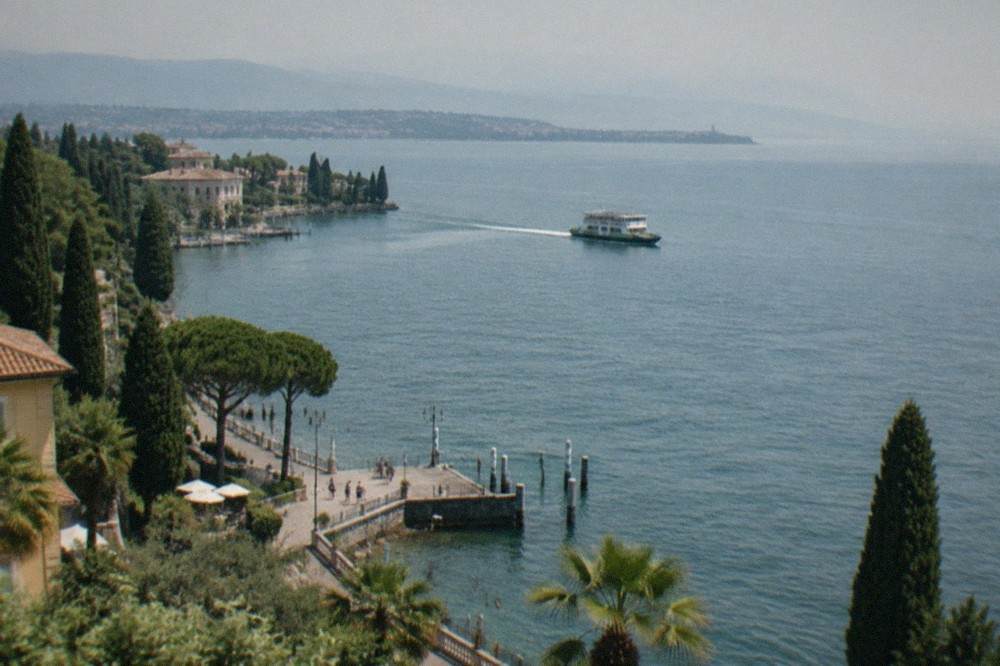
Garda's shape is the practical one for a visitor. It runs 54 kilometres from the wide, shallow, warm south around Sirmione and Peschiera del Garda to the narrow fjord-like north at Riva del Garda and Torbole, where the mountains close in and the wind funnels. You can, in a single day, take a morning boat past olive groves at Garda or Bardolino, cross to the western shore's Gardone Riviera, and still be back for a sunset loop of the Sirmione peninsula. On Como the equivalent day is shorter, steeper and more expensive, and the classic experience is a single ferry hop between three or four villa towns.
| Measure | Lake Garda | Lake Como |
|---|---|---|
| Area | 370 sq km | 146 sq km |
| Length | 54 km | about 47 km |
| Maximum width | up to 18 km | narrow, arms of a Y shape |
| Maximum depth | 346 m | 414 m, between Argegno and Nesso |
| Shoreline | 125 km | steep, largely cliff-backed |
| Public ferry landing stages | 28 | fewer, concentrated on the mid-lake triangle |
| Character of the shore | varied: bays, islands, plains in the south | steep villa shores, small waterfront towns |
The size difference is also a climate difference. Garda's broad southern basin warms earlier and holds its heat longer, which is why olive trees and even lemon groves thrive well north on its shores. Como's depth makes it a cooler, darker lake; beautiful, but not the swimming-and-sailing basin Garda is.
Which Is Easier To Get Around?
Garda is the easier lake to move around on, by a wide margin: a dense public ferry network with 28 landing stages, a summer timetable running to early October, and two railway stations on the Milan to Venice main line. Como's boats concentrate on the mid-lake triangle of Bellagio, Varenna and Menaggio, and its rail access serves only the eastern arm. On Garda you can genuinely be car-free; on Como you plan around a hub.
Start with the trains, because most visitors arrive from Milan or Verona. The fastest direct Trenord service from Milano Centrale to Varenna Esino, Como's classic lakeside rail stop, takes about 64 minutes, according to the operator's own route page. The fastest direct Trenord train from Desenzano del Garda to Milano Centrale takes about 83 minutes. Both lakes are therefore a day trip from Milan, but Garda adds Verona, Brescia and the Venice line to the map: Desenzano del Garda-Sirmione has three platforms and Peschiera del Garda two, both on the Milan to Venice main line, and both are a roughly 15 minute walk from their ferry landings.
On the water the gap widens. Garda's public fleet, run by the state navigation company from its Desenzano office, serves 28 landing places in the 2026 fare matrix, from Peschiera in the south-east to Riva and Torbole in the north. The summer timetable runs from 16 May to 4 October 2026 at maximum frequency, with a shoulder schedule either side. Fares are zonal: an adult one-way from Sirmione to Desenzano is EUR 3.50, Peschiera to Sirmione EUR 6.00, Sirmione to Riva EUR 16.00, and a whole-lake free-circulation day pass covering fast services too is EUR 39.50. The full scale and the day-pass zones are in the Lake Garda ferry guide, with the tariff sheet's own wording.
Como's public boats, run by the same state navigation company, are real and reliable, but the network is a triangle: most visitors stay inside Bellagio, Varenna, Menaggio and Como town, and the frequency drops sharply outside the central section. That is not a criticism, it is geography. Como is a Y, and only the middle stem has the crossings that make a ferry day work. Garda is a corridor, and a corridor is what a timetable likes.
One more practical note: on Garda, tickets can be bought on board with a EUR 1.00 surcharge per passenger when the ticket office is closed, and places are limited to the vessel's capacity, which in peak weeks matters. A traveller report from the summer of 2026 describes hours of queuing for northern ferries and the Monte Baldo cable car on a single bad day, and another describes managing a car-free week from Malcesine by ferry with no boarding trouble in June. Both are anecdotes, but they point at the same truth: Garda in August is a lake you share, and Garda in June is a lake you have.
Which Suits Families Better?
Garda suits families better on almost every measurable axis: warmer and more swimmable water, sandy and grassy beaches rather than steep shingle, an official bathing classification that rated all 65 sampling points on the Veneto shore excellent in 2026, and a spread of low-cost, short, shared boat tours that children can handle. Como's steep shores and villa-focus make it better for a child-free or older-family trip.
The swimming case is the clearest. Garda's southern basin is shallow and warm, with real beaches: Sirmione holds a Blue Flag for 2026, awarded to Spiaggia Giamaica and Lido delle Grotte, and Gardone Riviera, Limone sul Garda and Toscolano Maderno hold the same award, with Limone a new entry for its Tifù and Cola beaches. The regional environmental agency's 2026 monitoring rated every one of the 65 official bathing points on the Veneto shore excellent. Como can be swum in, from platforms and small patches, but it is a deep, cold lake with few gentle entries, and its fame is not built on beaches.
On the water, Garda's shared-tour roster is built for short attention spans. The half-day cruise from Peschiera del Garda, four hours with lunch included, runs from $72.30 per person and carries a 4.4 rating from 849 reviews; it is the format that lets a family spend a whole morning on the lake without chartering anything. Shorter still, the one-hour peninsula tour from Peschiera, capped at 18 people, runs from $22.95 per person with a 4.7 rating from 143 reviews.
Off the water, the two lakes diverge further. Garda's shore towns are flat, walled, strollable and full of ice cream: Peschiera's pentagonal Venetian fortress, part of a UNESCO serial site, is a walkable ring of ramparts and canals. The theme park at Castelnuovo del Garda opens its 2026 season on 28 March, with online one-day tickets from EUR 44, and it runs a free shuttle from Peschiera del Garda station, which pairs neatly with a train-and-boat arrival. Como's equivalent family day is a villa garden and a boat, lovely, but priced and paced for adults. For the wider picture of where to base with children, the Lake Garda towns guide breaks the shore down town by town.
Which Is Better For Time On The Water?
Garda is the better pick for time on the water, thanks to its reliable Peler and Ora wind cycle, with the north wind in the morning and the south wind from noon to sunset, which built the sailing and windsurf scene at Riva and Torbole. Tours run from a $13.77 shared 25-minute loop to private whole-boat charters, while Como offers mostly ferries, villa-boat tours and a few rentals.
The wind is the fact that surprises people who have only seen the postcards. The official tourism board's own description has the Peler blowing from the north for the first twelve hours of the day and the Ora, a south wind, from around noon until sunset, reaching speeds above 10 metres per second in the upper lake. That reliable daily engine is why Garda hosts the historic Centomiglia regatta from Bogliaco, why the sailing schools cluster at the northern end, and why a sailing trip on Garda is a genuine product category rather than a novelty. Como has wind too, but nothing with this metronomic reputation, and its deep basin is a ferry-and-villa lake more than a small-boat lake. Everything else covered here is indexed on Lake Garda Boat Tours.
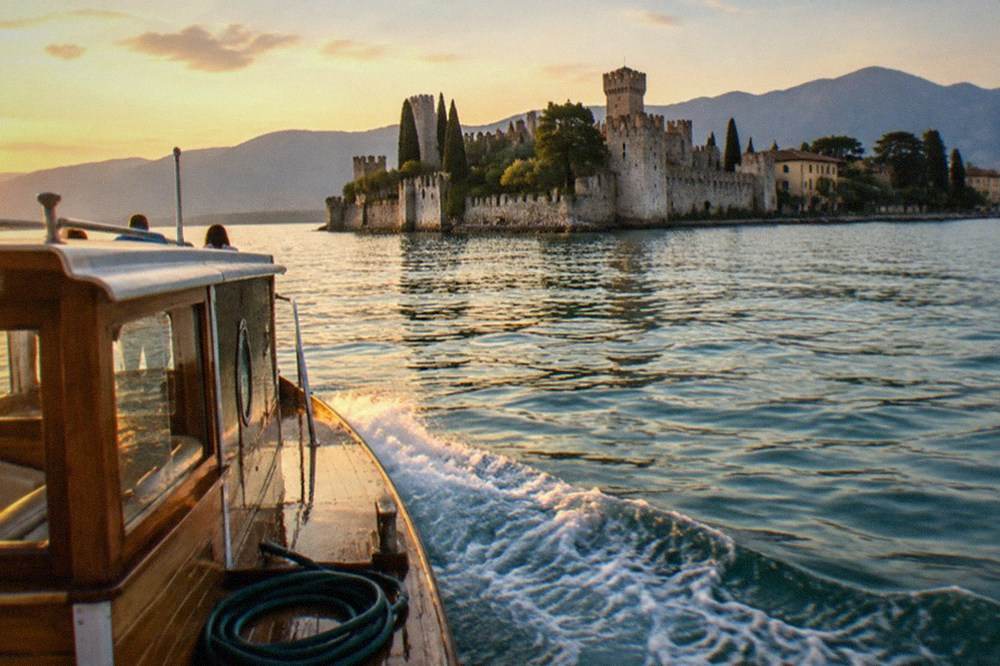
Garda's format spread is the other half of the case. At the bottom of the price scale sits the 25-minute shared cruise around the Sirmione peninsula, from $13.77 per person, rated 4.7 from 3,495 reviews, which loops the Scaliger castle, the Roman Grotte di Catullo and the sulphur spring at the tip. In the middle sit half-day and full-day guided cruises with lunch, wine tasting and swim stops. At the top sit private charters: a two-hour private island cruise with aperitif from $585.37 for the boat, up to six people, or an eight-hour private full-day tour from $1,931.72 for the boat. The whole spread, with what each format is for, is in the best boat trips on Lake Garda.
Como's water offer is not empty. The mid-lake ferry triangle is a pleasant half-day in itself, historic villa gardens open to the water, and private boat tours run from Como town and Bellagio. But the formats are fewer, the sailing infrastructure thinner, and the per-person floor higher. If your holiday is built around being on the water rather than looking at it, Garda is the lake that was made for you.
| What each lake is known for | Lake Garda | Lake Como |
|---|---|---|
| Signature water experience | Sailing, windsurfing, swim-stop cruises | Villa gardens seen from the water |
| Wind | Daily Peler and Ora cycle, northern funnel | Lighter, less predictable |
| Beaches | Blue Flag beaches at four towns in 2026 | Few, mostly platforms |
| Most famous sights | Sirmione peninsula and Scaliger castle, Grotte di Catullo, Isola del Garda, Vittoriale degli Italiani | Bellagio, Villa del Balbianello, Como town funicular |
| Ancient Rome | Grotte di Catullo Roman villa | Comum, Pliny's town |
| Modern fame | Sailing regattas, spa town of Sirmione | Film villas and celebrity residents |
| Crowd peak | August, driven by German school holidays | Summer weekends around the mid-lake triangle |
One Garda landmark deserves its own line in any fame comparison: the Vittoriale degli Italiani, Gabriele d'Annunzio's hillside estate at Gardone Riviera, recorded 303,403 visitors in 2025, a new all-time record for the site, achieved even with its Mausoleum closed for restoration from September. Como has nothing on the lake with that combination of literary history, architecture and visitor pull.
Which Is Busier And When?
Garda is the busier lake in absolute numbers, with preliminary regional figures showing almost 28 million tourist presences around its shore in 2025, but its crowds spread along 125 kilometres of shoreline with a predictable shape: August is the peak, driven by German school holidays, and Sirmione is the single most-visited spot. Como's crowds concentrate on a handful of small towns, so a summer weekend in Bellagio can feel tighter than anywhere on Garda.
The German holiday calendar is the hidden timetable of the southern shore. Bavaria's summer holidays in 2026 ran from 3 August to 14 September, and German visitors are the lake's largest single market, so those six weeks are when Garda's beaches, ferries and car parks fill. The regional statistics show the Lago di Garda area with tourists outnumbering residents in June, July and August, and 76.2 percent of 2025 arrivals coming from abroad. A traveller report from a car-free June week in Malcesine found the town "getting busy" but boarding boats without trouble, and warned of "very big queues later in the Summer". That is the pattern in one sentence.
Sirmione is the pressure point. It remains the most-visited locality on the lake, and for 2026 the town has responded with 31 pedestrianisation days of the historic centre between April and September, closing the ZTL to private vehicles from 14:00 to 19:00 on those dates, with free shuttle parking running until 21:00. The administration explicitly rejected a visitor cap, so there is no booking system for the peninsula itself, but the practical effect is that a summer afternoon in Sirmione is on foot, and the boat is the fastest way in and out.
Como's crowding is different in kind. Its presenze are lower in aggregate, but the mid-lake triangle funnels everyone into three small towns and a handful of villa gardens with timed tickets. In August, Bellagio's lanes and the Villa del Balbianello's gates can feel more congested than anything on Garda outside Sirmione. In June or September, both lakes are quiet by their own standards, and Garda's size means the quiet corners, Torri del Benaco, San Felice del Benaco, Brenzone, are genuinely quiet.
The timing advice that follows from the numbers: on Garda, aim for mid-June to mid-July, or September after the Bavarian schools go back, when the water is still warm and the ferry timetable is still at full summer frequency until 4 October. On Como, the same shoulder logic applies, but the mid-lake towns stay busy through most of the warm season, so the escape valve is the less-frequented western shore.
Which Is Cheaper?
Garda is the cheaper lake across the board: its public ferry one-ways run from EUR 1.50 for an urban hop to EUR 17.50 for the full length, its day pass is EUR 39.50, and its bookable boat tours start at $13.77 per person. Como's boat transport and tours sit at a higher price level, its villa gardens charge separate admissions, and its accommodation base skews boutique. Expect the water to cost less on Garda.
The ferry arithmetic alone tells most of the story. On Garda, an adult one-way in fare section 1, Sirmione to Desenzano, is EUR 3.50; section 2, Peschiera to Sirmione, EUR 6.00; the full crossing from Sirmione to Riva, EUR 16.00; and the whole-lake free-circulation day pass, valid on fast services too, EUR 39.50, with a three-day version at EUR 79.00. Zonal day passes for the upper, lower or single zones cost EUR 27.00 and EUR 23.50. On-board purchase adds only EUR 1.00 when the office is closed. Como's equivalent mid-lake hops and day tickets cost more per kilometre, and its private boat tours, the classic Como experience, start at a level Garda's shared tours simply do not touch.
On accommodation, both lakes have the same Italian summer pricing logic, but Garda's inventory is broader: family-run hotels in Bardolino, Lazise and Garda town sit alongside the luxury of Gardone Riviera, and Bardolino's official 2026 tourist tax runs from EUR 1.50 per person per night at one- to three-star hotels to EUR 2.50 at five-star, capped at 20 nights, with minors under 14 exempt. Como's lakeside towns skew smaller and pricier per room, and the famous villa gardens, the main paid sights, each charge their own admission on top.
If the comparison is coming down to cost, the cheapest way to test whether Garda's water is for you is the short loop: the 25-minute shared peninsula cruise from Sirmione, from $13.77 per person, rated 4.7 from 3,495 reviews, with free cancellation on the listing. It is the lowest-cost real boat experience on either lake, and it delivers the castle, the Roman ruins and the spring in one circuit.
Which Boat Trip Should You Book On Garda?
Book by format, not by town: the 25-minute Sirmione peninsula cruise from $13.77 per person is the cheap taster, the four-hour Peschiera cruise with lunch from $72.30 is the full morning, and the shared sunset tour from $35.12 per person is the evening aperitivo. Those three cover the short loop, the meal-and-swim format and the golden-hour sail, and every one carries free cancellation on its listing.
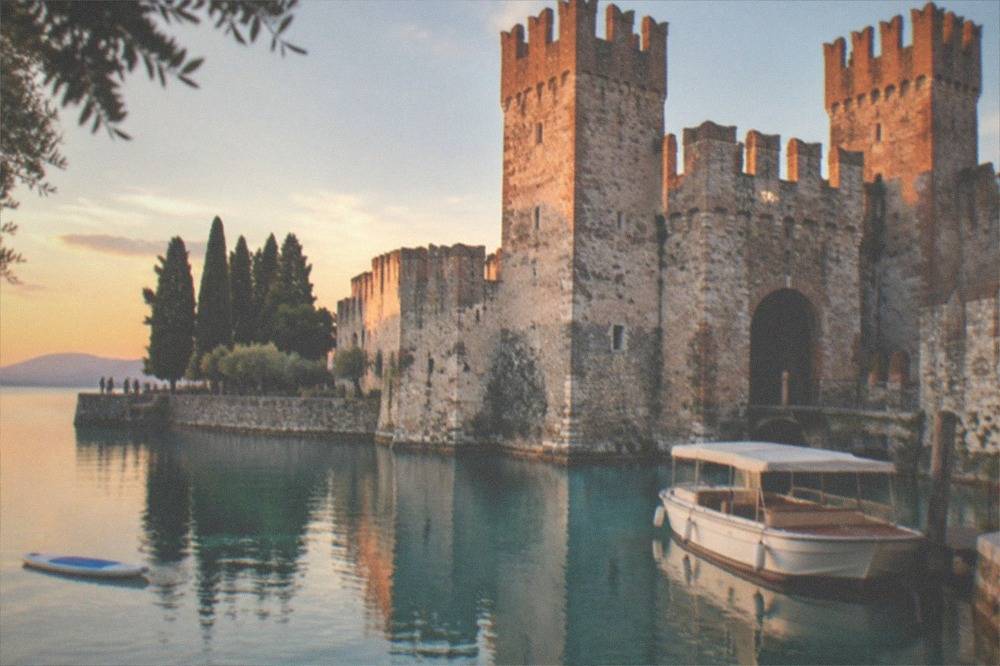
The cheap taster is the one most people should start with. The 25-minute peninsula cruise from Sirmione, 4.7 from 3,495 reviews, from $13.77 per person, loops the whole headland: the Scaliger castle moated by the lake, the cliffside Grotte di Catullo, the largest private Roman ruin in northern Italy, and the sulphur spring that made Sirmione a spa town two thousand years ago. It runs several times an hour in season from the landing beside the castle, and no other experience on either lake gives this much shoreline per dollar.
The full morning is the Peschiera half-day: four hours on the water with lunch included, from $72.30 per person, rated 4.4 from 849 reviews, departing the canal port inside Peschiera's fortress walls and typically cruising the south basin with time for a swim stop in warm months. For families and for anyone who wants the lake to be the whole day rather than a fragment of it, this is the format that earns its price.
The evening is the shared sunset tour from Sirmione, about 45 minutes, from $35.12 per person, capped at 20 people, rated 4.8 from 324 reviews, with an aperitivo served on board. Sunset at Sirmione falls around 20:24 at the start of May and 21:09 at the June solstice, so in high summer this is a genuinely late-evening trip, and the peninsula's west-facing cliffs hold the light.
| Garda boat format | Tour | Duration | Price | Rating and reviews |
|---|---|---|---|---|
| Short shared loop | Sirmione 25-minute peninsula cruise | 25 minutes | from $13.77 per person | 4.7 from 3,495 reviews |
| Half-day with lunch | Peschiera half-day cruise with lunch | 4 hours | from $72.30 per person | 4.4 from 849 reviews |
| Sunset aperitivo | Sirmione shared sunset tour | about 45 minutes | from $35.12 per person, cap 20 | 4.8 from 324 reviews |
| Guided crossing | East-coast cruise to Sirmione from Peschiera | 3.5 hours | from $68.86 per person | 4.7 from 423 reviews |
| Castle and wine | Historic castle cruise with wine tasting from Sirmione | 4 hours | from $114.76 per person | 4.6 from 300 reviews |
| Private island charter | Private Isola del Garda tour from Sirmione | about 1.5 hours | from $509.27 for the boat, up to 5 people | 4.9 from 413 reviews |
Beyond those three, the roster widens by purpose: guided crossings between towns if you want the boat to be your transport, wine-tasting cruises that pair the castle with local bottles, and private charters to Isola del Garda, the villa island on the western shore that can only be visited on a guided tour, with 2026 adult tickets at EUR 46 from Sirmione including the boat, the guide and a welcome drink. Whatever you pick, the button below always reads Check availability, never a price promise, because live dates and pricing sit on the operator's listing.
Common Questions About Which Is Nicer, Lake Como Or Garda?
Which Is Nicer, Lake Como Or Garda?
On measurable grounds Garda is the better all-round lake: larger at 370 square kilometres, warmer, easier to reach and get around with 28 ferry landing stages, cheaper on the water, and the only one of the two with a real sailing wind and beach scene. Como is nicer if what you want specifically is steep villa shores, deep dark water and small polished towns. Neither is nicer in the abstract.
Is Lake Garda Bigger Than Lake Como?
Yes. Garda covers 370 square kilometres and runs 54 kilometres long, against Como's 146 square kilometres and roughly 47 kilometres. Como is the deeper lake, reaching 414 metres against Garda's 346.
Which Lake Is Easier From Milan?
Both are day-trippable. The fastest direct train from Milano Centrale to Varenna on Como takes about 64 minutes; the fastest from Milano Centrale to Desenzano del Garda takes about 83 minutes. Garda then offers the denser network: 28 ferry landing stages against Como's concentrated mid-lake triangle.
Which Lake Is Better For Swimming?
Garda. Its southern basin is shallow and warm, and in 2026 the regional environmental agency rated all 65 official bathing points on its Veneto shore excellent, while four Garda towns including Sirmione and Limone sul Garda hold Blue Flags. Como is deep, cool and short of gentle beaches.
Which Lake Is Cheaper?
Garda. Public ferry one-ways run from EUR 1.50 to EUR 17.50 with a whole-lake day pass at EUR 39.50, and bookable boat tours start at $13.77 per person for the 25-minute Sirmione peninsula cruise. Como's boat transport and private tours sit at a higher level, and its villa gardens each charge separate admission.
When Should I Avoid Each Lake?
Avoid Garda in August, when German school holidays peak the crowds, and avoid Sirmione on summer afternoons generally. Avoid Como's mid-lake triangle, Bellagio, Varenna and Menaggio, on summer weekends. Mid-June to mid-July and September suit both lakes.