Do You Need To Book A Ferry On Lake Garda?
No, Lake Garda ferries need no advance booking: tickets are sold at the pier or on board with a one euro surcharge, and places are simply limited to the ship's capacity. Here is how that works in practice.
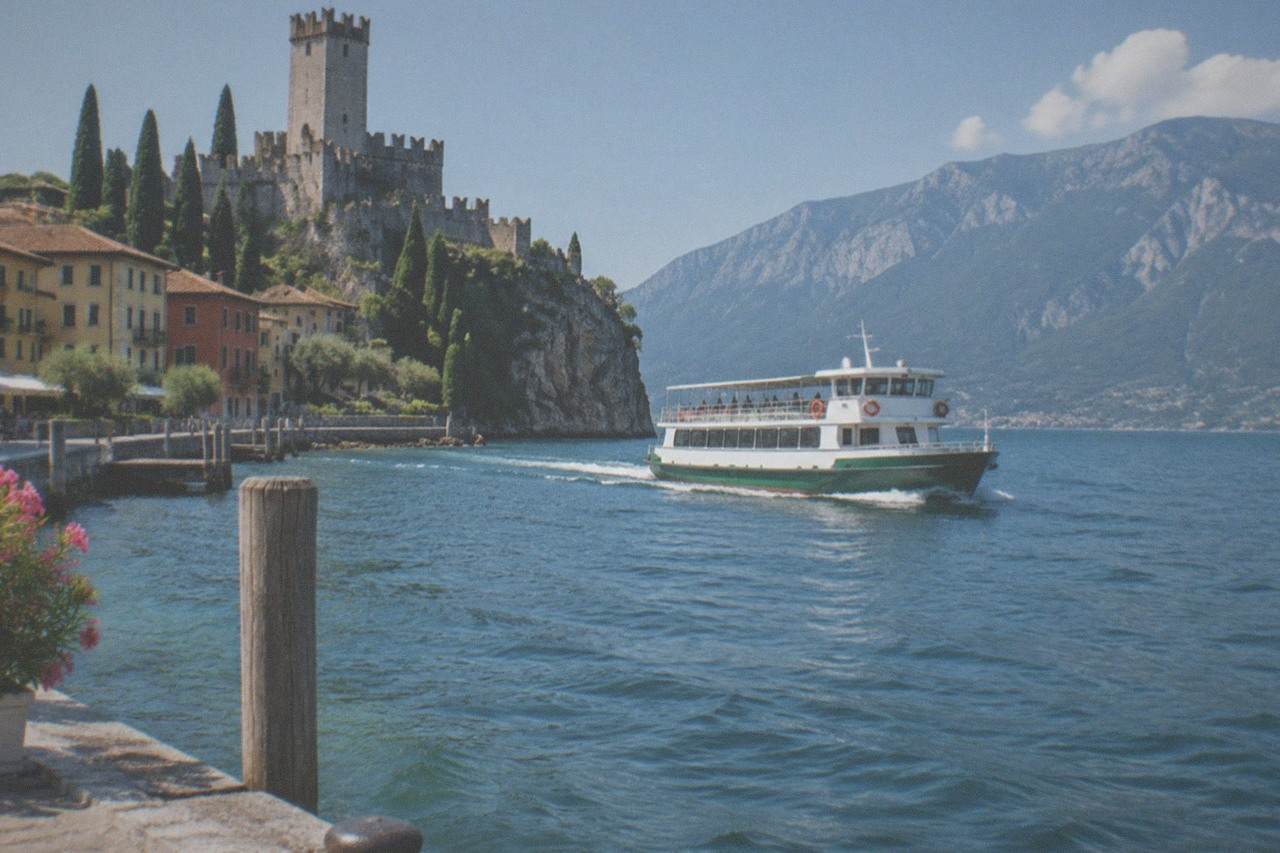
Do You Need To Book A Ferry On Lake Garda?
No, you do not need to book a ferry on Lake Garda. The public service run by Navigazione Laghi sells tickets at the pier offices and on board the boats themselves, with no reservation system for foot passengers and no advance purchase window. Places are limited to the maximum capacity of each motorship, so on peak summer afternoons the risk is not a sold-out timetable but a full gangway and a wait for the next sailing.
That is the honest split, and it matters because the two words "booking" and "ferry" pull in opposite directions on this lake. A ferry crossing is a scheduled public transport service, closer to a city bus than a restaurant: the timetable is published, the fare is fixed by a tariff sheet, and your seat is claimed by physically standing at the right pier at the right time. Nothing you do at a computer three weeks earlier changes your standing on that gangway. The operator's own summer timetable states plainly that places are limited to the maximum capacity of the motorship, which tells you everything about how the system handles demand: first at the rail, first aboard.
Where booking genuinely matters is on the other half of this lake's water traffic, the commercial boat tours. A tour operator holds a seat for you against a named departure, takes payment in advance, and cancels with a refund if the weather turns. Five listings on this site carry a real sell-out badge, and those are the ones where a late decision can genuinely cost you the day. The rest of this article separates the two systems so you know which half of your lake day needs a click in advance and which half needs nothing more than a ticket and good timing.
If you are weighing the ferry against a paid excursion generally, the comparison guide at Lake Garda ferry versus boat tour covers the trade-offs, and the practical side of a day on the water is laid out in what a Lake Garda boat ride is like.
For readers whose real question is "will I get on a boat at all", the answer on the ferry side is almost always yes. The summer timetable runs at maximum frequency from 16 May to 4 October 2026, with the full winter structure thinning after that, and the network's 28 landing places from Desenzano to Riva del Garda carry a volume of foot traffic that the fleet is sized for. The exception is a handful of peak days, and this article names them below rather than leaving you to guess.
How Do You Buy A Ferry Ticket?
You buy a Lake Garda ferry ticket in three ways: at the ticket office on the pier before boarding, from the contactless NaviTap system on board using a bank card or digital wallet, or from a crew member on board with a surcharge of one euro per passenger. There is no online seat reservation for ordinary passenger services, so no website step exists between you and the gangway.
The tariff sheet in force from 1 April 2026 sets the fares, and they are distance-based rather than route-based. The fare matrix divides the lake into seven sections plus an urban hop: an adult one-way costs EUR 3.50 in section 1, rising through EUR 6.00, 7.50, 11.50, 14.00 and 16.00 to EUR 17.50 for the longest crossings such as Desenzano to Riva. Sirmione to Desenzano sits in section 1 at EUR 3.50, Peschiera to Sirmione in section 2 at EUR 6.00, and Sirmione to Riva in section 6 at EUR 16.00. Children under four travel free provided they do not occupy a seat, and there are reduced columns for children aged 4 to 11, seniors, residents and groups. The full fare logic and day-pass prices are broken down in how much the ferries on Lake Garda cost.
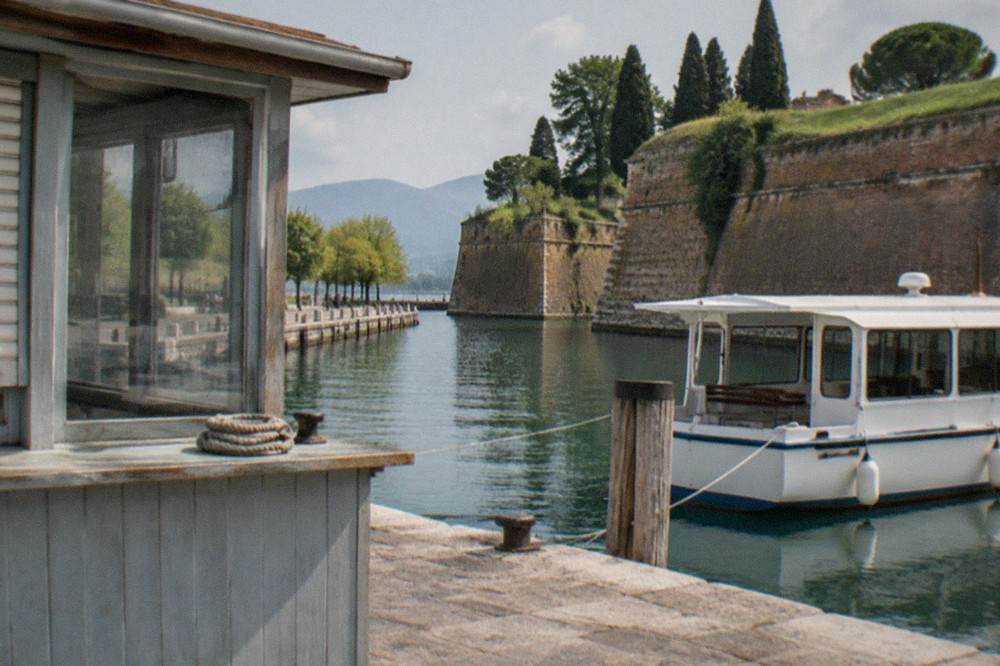
The on-board option is the one that surprises visitors who arrive at a small landing with the office shut or a queue moving too slowly. The operator's own terms allow purchase on board with a surcharge of one euro for each passenger, luggage item or vehicle, and the surcharge is not applied when the ticket office is closed. So a mid-evening boarding at a minor stop is not a problem, it is simply a euro more per head. The NaviTap contactless system adds a third route: tap a Visa, Mastercard or digital wallet on board to buy a daily ticket directly, with up to five tickets purchasable on a single card or device in one tap-in, and no fees attached.
| Where you buy | Surcharge | What you get | The capacity rule |
|---|---|---|---|
| Ticket office on the pier | None | Single, return or day ticket at tariff price | Boarding still limited to the ship's maximum capacity |
| On board from the crew | EUR 1.00 per passenger, luggage or vehicle; waived if the office is closed | Same tariff tickets | Same capacity rule, so late buyers queue behind early ones |
| NaviTap contactless on board | None | Daily tickets only, up to five per card or device | Same capacity rule |
Day passes deserve a sentence here because they change the arithmetic for anyone hopping between towns. A whole-lake day ticket costs EUR 39.50 adult and includes the fast services; upper-lake and lower-lake versions cost EUR 27.00, and single-zone day tickets EUR 23.50. If your plan is three or more hops, the day pass usually beats single fares bought one at a time. There is also an integrated Gardapass ticket at EUR 33.50 for 24 hours covering Arriva buses and the boats together, valid until 4 October 2026, which suits a base in one town and a circuit by water and road.
What Happens If The Boat Is Full?
If a Lake Garda ferry is full, the crew stops boarding and you wait for the next sailing on the same route. There is no standby list, no overbooking queue and no priority for earlier ticket holders, because the tariff states that places are limited to the maximum capacity of the motorship. In July and August on the southern routes, that can mean watching one boat leave and catching the next.
This is the single most misunderstood part of the system. People read "no booking needed" as "no capacity limit", and the two are unrelated. The fleet is sized for the timetable, not for the peak half hour of a Ferragosto afternoon, and the operator makes no secret of it: the summer timetable carries the capacity line as a standing rule. What protects you is frequency. On the busiest southern corridors in the 16 May to 4 October summer window, sailings are close enough together that a missed boat costs you a gelato by the pier rather than a morning.
The practical defences are all behavioural. Travel early: the morning departures between 8.00 and midday carry a fraction of the afternoon load, and the first crossings of the day are the ones a first-time visitor should be aiming for. Travel light on the bike: the operator restricts bicycle and scooter carriage at Sirmione during the summer timetable, so a two-wheel plan that assumes every boat takes every bike will fail at exactly the port where most visitors try it. And check the timetable rather than the crowd: the published sheet, not the size of the queue, tells you whether the next boat is in twenty minutes or two hours. The route network and seasonal structure are mapped out in the Lake Garda ferry guide.
A recent traveller report from the 2026 season describes the failure mode plainly: a visitor in the northern basin spent several hours queueing across ferries and the Monte Baldo cable car on a single day and missed the last direct sailing, ending up on a bus instead. That is an August-peak story with a car-free itinerary stacked end to end, not a description of an ordinary Tuesday in June. But it is the honest upper bound of what a no-booking system asks of you on its worst day: the timetable always runs, only your place on each individual boat is unreserved.
Is There A Surcharge On Board?
Yes, buying a ticket on board a Lake Garda ferry costs one euro more per passenger, per luggage item or per vehicle than buying at the pier office, and the surcharge is dropped entirely when the ticket office is closed. The fast services carry a separate supplement on top of the ordinary fare, published as a scale from EUR 2.50 to EUR 6.00 per section, and the whole-lake day ticket at EUR 39.50 already includes them.
The on-board surcharge is the operator's way of pushing routine purchases to the windows without ever refusing a late buyer. One euro is small enough that it should never be the reason you miss a boat: if the office queue is long and the gangway is about to lift, the arithmetic favours paying the euro and boarding. The reverse also holds, in that the surcharge is not a penalty for small landings without staffed offices, because those count as the office being closed and the fare reverts to tariff price.
The fast-service supplement is the second surcharge and the one that actually catches people out. The aliscafi and rapid vessels cut crossing times substantially on the long north-south runs, and the tariff sheet is explicit that boarding a rapid service requires the specific supplement on top of the ordinary fare. The per-section amounts sit on a published scale from EUR 2.50 to EUR 6.00. Day-pass holders dodge this entirely on the whole-lake ticket, which includes the fast services, while zone and lower-lake pass holders must add the supplement to board a rapid crossing.
Two smaller notes complete the picture. Reduced fares exist for children aged 4 to 11, for seniors, residents and groups, and for schools, so a family of four on a section 2 crossing is not paying four adult tariffs. And the NaviTap contactless route, which sells daily tickets on board with no surcharge at all, is worth knowing for the return leg of a day trip when the office at a minor landing has shut for the evening.
When Is The Network Busiest?
The Lake Garda ferry network is busiest from late July through August, on weekends, and on the Ferragosto holiday of 15 August above all, when the 2026 holiday falls on a Saturday and stacks holiday traffic onto weekend traffic. The full-frequency summer timetable runs 16 May to 4 October 2026, and within it the afternoons on the southern routes, Sirmione, Peschiera, Desenzano and Lazise, carry the heaviest loads.
The seasonal shape is fixed and predictable. The summer timetable published by the operator runs at maximum frequency from 16 May to 4 October 2026, and everything outside that window is thinner, with the autumn and winter service reducing coverage after 4 October. Within the summer, the demand curve follows the classic Italian holiday rhythm: German visitors are the lake's largest single market, and the Bavarian school holidays in 2026 run from 3 August to 14 September, which is why the first three weeks of August feel like a different lake from June. Regional statistics for the Veneto shore show tourists outnumbering residents in June, July and August, and the boats share in that swell.
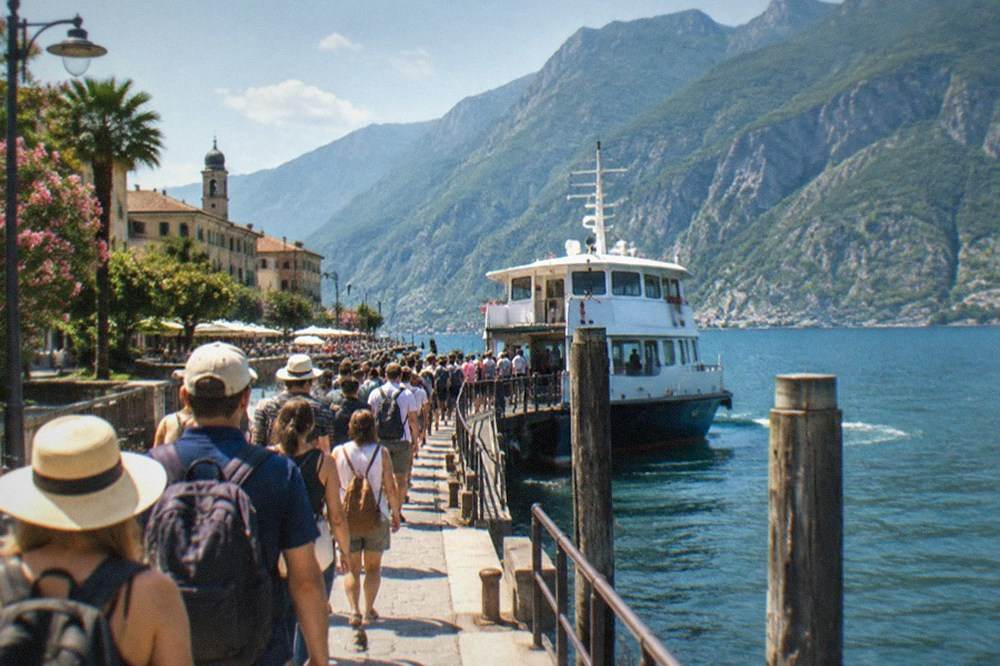
The daily shape matters as much as the monthly one. Morning boats run comfortable; afternoon boats, especially the ones converging on Sirmione between 14.00 and 18.00, board to capacity. The town's own 2026 access plan adds a second pressure valve: Sirmione pedestrianises its historic centre on 31 days across the season between 14.00 and 19.00, which pushes day visitors toward the waterfront and the piers exactly when the afternoon boats are fullest. If your itinerary puts you on a mid-afternoon Sirmione crossing in August, you are standing at the intersection of every crowd pattern this lake has.
The quiet windows, for planning purposes, are these: May and the first half of June before the German holidays start, September after the 14th, weekday mornings at any point in the season, and the shoulder hour of early evening when day-trippers have already gone home. The timetable does not shrink in these windows, only the queue does, and a ferry that leaves half empty at 9.00 will leave standing room only at 16.00 on the same route. For anyone wondering whether a looser pattern of hopping on and off exists, the answer is in whether there is a hop-on hop-off boat on Lake Garda.
Do Boat Tours Need Booking Instead?
Yes, booked boat tours are the opposite of the ferry in every respect that matters: a booking holds a named seat on a named departure, payment is taken in advance, and the operator owes you a refund if they cancel, including for weather. Five listings on this site carry a genuine sell-out badge, and those are the tours where waiting until the day itself is a real gamble rather than a mild inconvenience.
The contrast is worth spelling out because visitors routinely conflate the two systems. A ferry ticket, even a day pass, is an open right to travel, exercised whenever you present yourself. A booked tour is a contract: the operator has counted you into a group size, sometimes a small one, and your absence or late arrival has a cost they have already absorbed. That is why tours can offer what the ferry cannot, a guaranteed place at a guaranteed time, and why their cancellation terms are published and enforceable rather than left to a pier-side shrug.
The roster on this site shows the spread. The East-Coast Cruise to Sirmione from Peschiera del Garda runs 3.5 hours, is rated 4.7 from 423 reviews and costs from $68.86 per person, and its capacity is a finite number of seats on a single daily vessel. The Half-Day Cruise with Lunch from the same port runs 4 hours, rated 4.4 from 849 reviews, from $72.30 per person. And the short Sirmione peninsula loop, 25 minutes, rated 4.7 from 3,495 reviews, from $13.77 per person, is the cheap taster that sells on volume and turns over passengers all day. All three carry free cancellation on the listing, which is the second half of the booking bargain: your seat is held, and your money comes back if your plans change in time.
The Peschiera 2-hour speedboat tour is the clearest case on the roster for booking ahead, because it is one of the five listings that carries a real sell-out badge. It runs 2 hours from Peschiera del Garda, rated 4.7 from 162 reviews, from $40.17 per person, and a speedboat has fewer seats than any ferry on the lake. This is the one product type where the honest advice flips from "just turn up" to "book it or accept the risk", and no other listing on the site earns that urgency line.
| Public ferry | Booked boat tour | |
|---|---|---|
| How you secure a place | Arrive at the pier and board, capacity permitting | Book in advance; a seat is held for you |
| Payment | At the office, on board, or by contactless tap | Online at the time of booking |
| If it is full | You wait for the next sailing | You were never in a queue; the seat was yours |
| Cancellation | No refund mechanism; you simply do not travel | Free cancellation on the listing where shown; operator refunds if they cancel |
| Best for | Flexible hopping between towns | A fixed experience at a fixed time |
What Happens If Weather Stops A Sailing?
If weather stops a Lake Garda ferry sailing, the timetable simply resumes with the next departure and your ticket stays valid for travel; there is no refund to chase because you had not paid for a specific crossing. On a booked tour, the published terms work the other way: if the operator cancels because conditions make the activity impossible or unsafe, the price paid is refunded in full, and standard listings allow cancellation up to 24 hours before departure.
The lake's weather is regular enough to plan around. The morning northerly Pelèr blows from around 2 or 3 a.m. until midday, then the southerly Ora takes over from noon until sunset, and on settled days this pattern repeats without drama. The genuinely disruptive winds are rarer: the Balinot, a descending north-west wind funnelling down past Riva, can exceed 20 metres per second and build higher waves than the morning breeze, and the Vinessa, a south-east wind tied to Adriatic weather systems, can hold for two or three consecutive days. When a sailing is suspended on a day like that, the operator's notices page carries it, and the fleet does not sail into it for the sake of a timetable.
For the ferry traveller, a weather suspension is an inconvenience, not a loss. You have a ticket for a route, not a seat on a hull, and the ticket remains usable when service resumes. For the tour traveller, the terms are the protection. The standard cancellation conditions published by the booking platforms allow a full refund for cancellations made more than 24 hours before the start of the activity, with no refund inside that window, and the same terms oblige the supplier to refund in full when they cancel for circumstances beyond their control, which the text names to include adverse weather. Some products are marked all sales final, and a commenced activity is not refunded, so the listing's own terms, not a general rule, are what govern your specific booking.
The practical read is this: weather risk on the ferry is a scheduling problem, and weather risk on a tour is a refund problem, and both resolve in your favour if you check the right thing. For the ferry, check the notices and the sky. For a tour, check the cancellation line on the listing before you pay, and prefer the listings that show free cancellation, which is most of the roster on this site.
Which Boat Should You Book Ahead?
Book ahead, rather than turn up, in four cases: any of the five listings carrying a real sell-out badge, private boat tours where one family books the whole vessel, small-group tours with a stated cap, and any departure tied to a fixed onward plan such as a train home. The public ferry should never be pre-booked, because the system does not sell advance seats at all; your effort is better spent choosing an off-peak departure time.
The sell-out question has a hard answer on this site because the badges are real rather than marketing. Five listings carry one: the private sunset cruise with local wine from Sirmione, the Peschiera 2-hour speedboat tour, the Fiat 500 boat tour with skipper from Sirmione, and two of the Verona day trips that bundle a Sirmione cruise. Those five, and only those five, justify the phrase "books up": everything else on the roster can usually be arranged a day or two out in shoulder season, though August weekends tighten everything.
Private tours are the second category, for an arithmetic reason rather than a badge. When a booking covers the whole boat, from $152.20 for a 25-minute private peninsula tour up to $509.27 for the private Isola del Garda cruise with its cap of five people, one booking removes the entire product from the day's inventory. Shared tours with a group cap behave the same way at a smaller scale: the 1-hour peninsula tour from Peschiera caps at 18 people, and the shared sunset tour from Sirmione caps at 20. A cap is a promise of intimacy that converts directly into scarcity.
The fourth case is the one people forget: fixed onward plans. If your last ferry of the day is the only one that connects to your train, the ferry's no-booking nature stops being a convenience and becomes a single point of failure. On days like that, a booked afternoon tour with a guaranteed end time, or simply an earlier ferry than strictly necessary, is the safer choice. The site's own Lake Garda Boat Tours roster exists precisely to sort those two worlds, and the pairing of a morning ferry hop with one booked afternoon excursion is the pattern that gets the most out of both.
| Cancellation scenario | Public ferry | Booked tour, standard listing | Booked tour, all sales final |
|---|---|---|---|
| You change plans a week out | Ticket unused; day passes have no refund mechanism | Full refund, per the standard 24-hour-plus terms | No refund |
| You cancel inside 24 hours | Nothing to cancel; you just do not board | No refund under the standard terms | No refund |
| Operator cancels for weather | Next sailing takes you; ticket still valid | Full refund of the price paid | Refund due if the supplier cancels |
| You are late to the departure | Wait for the next sailing | Treated as a no-show; no refund | No refund |
Common Questions About Do You Need To Book A Ferry On Lake Garda?
Do You Need To Book A Ferry On Lake Garda?
No. The public ferry service sells tickets at pier offices and on board, with a one euro on-board surcharge, and has no advance reservation system for foot passengers. The only limit is the ship's maximum capacity, so on peak August afternoons you may wait for the next sailing.
Can you buy a Lake Garda ferry ticket online?
Not a seat on an ordinary passenger sailing. You can buy daily free-circulation tickets through the operator's own channels and contactless NaviTap purchases on board, but there is no online booking that reserves you a place on a specific departure.
What happens if the ferry is full when I arrive?
You wait for the next sailing on that route. The tariff states that places are limited to the maximum capacity of the motorship, and boarding follows the order of the queue. In the summer timetable, sailings on the main southern routes are frequent enough that the wait is usually under an hour.
Do Lake Garda boat tours need to be booked in advance?
Most benefit from booking because a seat is held for you, and five listings on this site carry a genuine sell-out badge, including the Peschiera 2-hour speedboat tour. Private tours and small-group tours with caps should always be booked ahead in July and August.
Is there a surcharge for buying a ferry ticket on board?
Yes, one euro per passenger, luggage item or vehicle, and it is waived when the ticket office is closed. Fast services carry a separate supplement on a scale from EUR 2.50 to EUR 6.00 per section, which the whole-lake day ticket at EUR 39.50 already includes.
What if bad weather cancels my sailing or tour?
A suspended ferry sailing costs you nothing except time, since your ticket stays valid for the next departure. A cancelled tour is refunded in full under the platforms' published terms when the operator cancels for weather, and standard listings allow free cancellation up to 24 hours before departure.